August 11, 2026
Why All-Electric Melting Matters for High Borosilicate Glass Quality
Introduction
For buyers of high borosilicate glass, the furnace may seem far removed from the finished bottle, tube, container, cookware component, or laboratory glass product they are actually sourcing. In practice, however, melting technology has a direct influence on glass homogeneity, thermal history, composition stability, and production consistency.
That is why all-electric melting deserves attention.
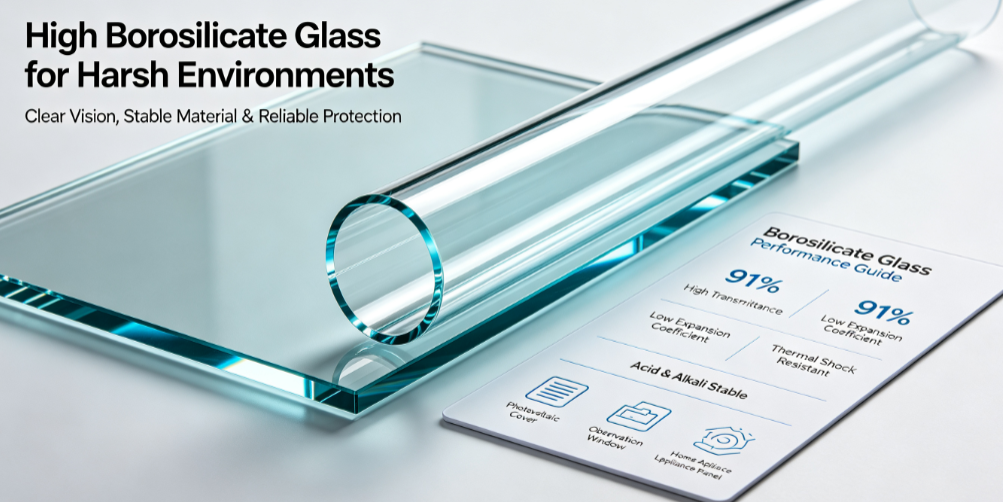
High borosilicate glass is valued for its low thermal expansion, thermal shock resistance, and chemical durability. Corning, for example, describes borosilicate glass as a material known for heat and chemical resistance, which explains its long-standing use in demanding laboratory and technical applications. Achieving these properties consistently starts long before forming or finishing. The melt itself has to be stable.
A high borosilicate glass all-electric melting furnace heats the glass through electrical energy rather than relying primarily on flame radiation above the melt. This difference changes the thermal environment inside the furnace and can bring practical benefits in volatile-component retention, temperature control, glass uniformity, energy use, and furnace footprint.
For glass product buyers, those are not abstract furnace-engineering advantages. They can affect batch-to-batch consistency, forming behavior, defect control, and the reliability of the finished glass supplied to downstream applications.
Table of Contents
· Why Melting Quality Matters for High Borosilicate Glass
· How All-Electric Melting Works Differently
· Seven Practical Advantages of All-Electric Melting
· All-Electric vs Flame Melting: What Changes?
· Why Boron Volatilization Deserves Attention
· Operating Stability and Production Consistency
· Power Interruptions and Furnace Control
· What Glass Buyers Should Ask Their Supplier
· A Real Industry Shift Toward Electric Glass Melting
· Frequently Asked Questions
Why Melting Quality Matters for High Borosilicate Glass
High borosilicate glass is not simply ordinary glass melted at a different temperature.
Its composition typically relies on silica and boron-containing ingredients to achieve a relatively low coefficient of thermal expansion and strong resistance to temperature changes. These characteristics are why borosilicate materials are widely associated with laboratory glassware, technical glass, heat-resistant containers, and other applications where dimensional and thermal stability matter. Corning notes that borosilicate glass combines chemical durability with resistance to thermal shock, two properties that are especially valuable when glass products experience repeated heating, cooling, or contact with chemicals.
But boron-containing batches introduce a manufacturing challenge: some batch components are relatively volatile at high temperature.
If the melting process allows excessive volatilization, the actual glass composition can shift away from the intended formulation. That may influence downstream viscosity, forming behavior, and final material performance.
So when buyers evaluate high borosilicate glass, melt control matters just as much as what appears on a finished-product specification sheet.
How All-Electric Melting Works Differently
A conventional flame-fired furnace transfers a large amount of heat from the combustion space above the glass surface. The flame heats the furnace atmosphere and refractory structure, and heat then reaches the glass through radiation and convection.
An all-electric furnace takes a different route.
Because molten glass can conduct electricity under appropriate operating conditions, electrical energy can be introduced directly into the glass bath. The glass therefore becomes part of the heating system itself.
This is often described as internal heating.
For a cold-top or vertically melting configuration, fresh batch forms a layer above the molten glass. Instead of exposing the entire melt surface directly to an extremely hot combustion atmosphere, much of the melting process occurs beneath that batch layer.
The U.S. Department of Energy has continued to support research into advanced electric glass melting, including projects using cold-top furnace concepts, reflecting the industry’s interest in reducing energy use and emissions while maintaining production capability.
Seven Practical Advantages of All-Electric Melting
1. Less Combustion-Related Exhaust
The most obvious difference is the absence of a conventional combustion flame as the primary heat source.
Without large volumes of combustion gases continuously passing through the melting chamber, the furnace can reduce the exhaust burden associated with fuel-fired melting.
This matters from both an environmental and process perspective.
European Best Available Techniques documentation for glass manufacturing identifies electric melting as a route capable of achieving substantially lower furnace-related NOx emission levels in several glass sectors compared with conventional fuel-fired approaches. For special glass production, the EU BAT conclusions report electric melting associated with NOx levels below 100 mg/Nm³ under the stated conditions.
For buyers, lower combustion-related emissions do not automatically make a glass product better. What they do show is that the production route can reduce one of the major environmental burdens associated with traditional melting.
2. Better Retention of Volatile Batch Components
This point is particularly relevant to high borosilicate glass.
In a vertically melting cold-top furnace, volatile components released during melting can encounter the cooler batch layer above the melt. Part of this material may condense within that layer and return to the glass as the batch continues downward and melts.
That mechanism can help reduce losses of volatile boron- and alkali-containing components.
Why should a glass buyer care?
Because controlling volatilization helps the manufacturer keep the actual melt closer to the intended formulation. Composition stability is one of the foundations of repeatable glass properties.
3. More Uniform Thermal History
Glass homogeneity is rarely the result of a single parameter. Batch preparation, melting, refining, furnace circulation, residence time, and temperature distribution all play a part.
All-electric melting has an important advantage here: much of the glass can experience a more consistent thermal route through the furnace.
Rather than depending heavily on surface heating from a flame, electrical energy is delivered within the conductive glass bath.
In well-controlled production, this can support more uniform glass delivered to the forming process.
For buyers purchasing large quantities of borosilicate glass products, that consistency can be more valuable than a headline production speed. A product that performs well in one batch but behaves differently in another creates problems downstream.
4. Output Can Be Compensated as the Furnace Ages
A fuel-fired furnace generally changes over its operating life.
Refractory wear, furnace condition, and deterioration of combustion-system performance can gradually affect heat input and melting capability.
An all-electric furnace provides another control lever: electrical power input.
As heat losses change, voltage and power can be adjusted within the furnace’s engineered operating range to compensate for those losses and help maintain melting output.
That does not mean an electric furnace is maintenance-free. Electrodes, refractories, transformers, cooling systems, electrical connections, and instrumentation still require careful management.
What it does mean is that electrical input can be controlled quickly and directly.
5. Smaller Furnace Footprint
A conventional regenerative glass furnace may require much more than the melting tank itself.
Depending on furnace design, associated systems can include regenerators, combustion-air equipment, flues, exhaust handling, and chimney infrastructure.
An all-electric furnace can be structurally simpler because much of that combustion-related equipment is unnecessary.
The result can be:
· Smaller plant footprint
· Fewer combustion-related auxiliary systems
· Simpler furnace arrangement
· Lower space demand for the melting section
That can be useful for specialty glass production where capacity, flexibility, and process control may matter more than building the largest possible furnace.
6. Lower Heat Loss and Higher Thermal Efficiency
Glass melting is one of the most energy-intensive stages of glass manufacturing. U.S. Department of Energy studies identify the melting furnace as the major energy-consuming process in industrial glass production.
The reason is easy to understand: glass has to be heated to extremely high temperatures, and a traditional furnace loses energy through exhaust gases, furnace walls, crowns, openings, and other surfaces.
In the operating data supplied for the high borosilicate all-electric furnace discussed here, the cold-top furnace space above the batch is approximately 100–250°C, while the upper-space temperature of the referenced flame-fired high borosilicate furnace can reach approximately 1,640°C.
The same operating data indicate thermal efficiency of approximately 78% for the electric melting system, compared with up to approximately 30% for the referenced flame-fired configuration. Electrical consumption is reported at approximately 1.0–1.2 kWh per kilogram of molten glass.
These figures should not be treated as universal values for every furnace. Actual energy consumption depends on glass composition, furnace capacity, cullet ratio, pull rate, insulation, electrode arrangement, operating age, and production conditions.
Still, they illustrate why direct electrical heating can reduce some of the thermal losses inherent in flame-based melting.
Production Factor | Flame-Fired Melting | All-Electric High Borosilicate Melting |
Primary heat transfer | Flame radiation and convection | Electrical heating within molten glass |
Combustion exhaust | Present | Greatly reduced at furnace level |
Upper furnace temperature in referenced operating data | Up to approx. 1,640°C | Approx. 100–250°C with cold top |
Volatile-component retention | Greater exposure to hot furnace atmosphere | Cold-top layer can help capture volatile material |
Reported thermal efficiency for referenced configuration | Up to approx. 30% | Approx. 78% |
Reported electrical consumption | Not directly comparable | Approx. 1.0–1.2 kWh/kg glass |
Furnace-related infrastructure | More combustion and exhaust equipment | More compact configuration possible |
The important point is not that one set of numbers applies everywhere. It is that the heating mechanism changes where energy enters the process and where energy is lost.
7. Faster and More Precise Process Adjustment
Electrical heating is highly controllable.
Operators can manage power input through electrical parameters rather than relying only on adjustments to fuel flow, combustion air, flame characteristics, and furnace atmosphere.
For specialty glass, this can make thermal management more responsive.
Stable operation still depends on disciplined control of several variables, especially:
· Batch feeding
· Furnace temperature
· Glass level
· Glass pull rate
These four areas should remain coordinated. Changing one without understanding its effect on the others can disturb the entire melting process.
Why Boron Volatilization Deserves Attention
For a glass product buyer, the chemical composition printed on a technical data sheet may appear fixed.
From the manufacturer’s perspective, maintaining that composition through melting takes work.
Borosilicate formulations contain components that may volatilize at high furnace temperatures. If volatile losses become excessive or inconsistent, the actual melt chemistry can change.
The cold-top arrangement of an electric furnace can help here because the fresh batch layer acts as a cooler zone above the molten glass.
Volatile material moving upward can condense into this batch layer rather than immediately leaving with a high-volume combustion exhaust stream. As that material descends with the batch, it can return to the molten glass.
This is one reason electric melting is particularly interesting for specialty glass compositions where chemistry must stay under close control.
Operating Stability and Production Consistency
Good furnace technology still needs good operation.
For an all-electric glass furnace, electrical current, furnace resistance, input power, and glass temperature are interrelated.
Operators cannot simply increase current whenever more heat seems necessary.
Electrical loading has to remain within the designed capability of transformers, cables, electrodes, power-control systems, and the furnace itself.
That is why stable production normally depends on what operators often describe as four steady conditions:
Stable Feeding
Batch should enter at a controlled rate, with reasonably uniform cold-top coverage.
Stable Temperature
Electrical input and furnace resistance need to be managed so that temperature changes remain controlled rather than abrupt.
Stable Glass Level
The glass level should remain within the specified operating range to protect both process stability and furnace condition.
Stable Pull Rate
The amount of glass leaving the furnace should remain coordinated with melting capacity and batch feeding.
These sound simple on paper. In production, maintaining all four simultaneously is where experienced furnace operation matters.
Power Interruptions and Furnace Control
Power loss deserves special attention in an all-electric furnace because electricity is the primary source of melting heat.
The operating guidance supplied with this furnace distinguishes between relatively short interruptions and longer outages, including events lasting approximately two hours and events extending into the two-to-eight-hour range.
However, outage response should never rely on a generic timing rule alone.
The correct action depends on:
· Furnace size and thermal inertia
· Glass composition
· Current glass temperature
· Electrode arrangement
· Backup electrical design
· Transformer condition
· Plant emergency procedures
For this reason, facilities operating electric glass furnaces should have site-specific emergency procedures, trained personnel, and properly engineered backup-power arrangements where required.
From a buyer’s perspective, this is another useful supplier question: does the glass manufacturer manage its melting process through defined operating procedures rather than depending mainly on operator judgment?
What Glass Buyers Should Ask Their Supplier
Most buyers do not need to audit every furnace parameter. Still, a few manufacturing questions can reveal a great deal about product consistency.
When sourcing high borosilicate glass, consider asking:
· How is glass composition controlled during melting?
· How does the furnace minimize boron and alkali volatilization?
· How are temperature and glass level monitored?
· How is batch-to-batch consistency verified?
· What quality checks are performed before forming or shipment?
· How are process deviations handled?
· Is the melting process designed for continuous stable output?
This is especially useful when purchasing products for laboratory, thermal, technical, industrial, or repeated-heating applications.
Price matters, of course. But when the application depends on material stability, the process behind the price matters too.
A Real Industry Shift Toward Electric Glass Melting
Electric melting is not just a niche technical discussion.
In 2024, the U.S. Department of Energy announced support for a Glass Manufacturing Industry Council project focused on advanced electric melting to decarbonize commercial glass production. The work includes modeling, laboratory experiments, and furnace-design development.
The DOE has also supported hybrid-electric glass furnace demonstration projects. In one current U.S. industrial demonstration, a hybrid furnace project aims to replace up to 80% of melting energy with electricity and reduce facility carbon intensity by as much as 50%.
These projects are not the same as the high borosilicate all-electric furnace described here, and they should not be treated as direct performance comparisons.
They do, however, show a clear industry direction: glass producers are taking electrified melting seriously as they look for better control over energy use, emissions, and future furnace design.
Frequently Asked Questions
What is high borosilicate glass?
High borosilicate glass is a boron-containing silicate glass designed to provide low thermal expansion, good thermal shock resistance, and strong chemical durability. These properties make borosilicate glass suitable for laboratory products, heat-resistant glassware, technical glass components, and other demanding applications.
Why is all-electric melting suitable for high borosilicate glass?
All-electric melting introduces heat directly into the conductive molten glass rather than depending mainly on flame heating from above. A cold-top configuration can also help retain volatile batch components, support more consistent thermal conditions, and reduce combustion-related furnace emissions.
Does an electric furnace automatically produce better glass?
No. Furnace type is only one part of glass quality. Batch formulation, raw material control, refining, temperature management, glass level, forming conditions, annealing, inspection, and overall process discipline remain important. The value of all-electric melting is that it gives manufacturers useful tools for controlling several important parts of the melting process.
What should buyers focus on when purchasing high borosilicate glass products?
Buyers should look beyond appearance and price. Important factors include composition consistency, thermal performance, dimensional control, annealing quality, defect inspection, batch traceability, and whether the manufacturing process is stable enough to reproduce the required properties over repeated orders.
Conclusion
For buyers, high borosilicate glass quality begins well before the glass reaches a forming machine.
The melting process influences composition stability, thermal history, homogeneity, energy use, and ultimately the repeatability of finished products. An all-electric melting furnace offers several meaningful advantages for high borosilicate production, including reduced combustion-related exhaust, better retention of volatile components, more direct thermal control, a smaller furnace footprint, and the potential for higher thermal efficiency.
Just as important, electric melting rewards disciplined operation. Stable feeding, temperature, glass level, and pull rate remain essential, while electrical loading and emergency procedures must be carefully controlled.
For buyers sourcing high borosilicate glass for thermal, laboratory, industrial, or other demanding applications, understanding how the glass is melted can make supplier evaluation much more meaningful.
Contact us to discuss your high borosilicate glass requirements, product specifications, application conditions, or customized glass solution.