November 10, 2026
Heat Resistant Glass: A Technical Buyer's Guide to Borosilicate and High-Temperature Glass
A technical procurement guide to heat resistant glass: borosilicate composition, thermal shock mechanics, measurable selection criteria, failure modes, inspection methods, and verification steps for industrial and glassware buyers.
What “Heat Resistant Glass” Actually Means in a Purchase Specification
Heat resistant glass is not a single material. In procurement, the term covers several glass families selected for their ability to survive elevated service temperatures and, more often, rapid temperature change. The two properties are related but not identical: a glass can tolerate a high steady temperature yet crack when cooled quickly, or survive a thermal cycle yet deform under sustained load.
For most buyers specifying transparent heat resistant glass, the practical choice is borosilicate glass, typically borosilicate 3.3, whose low thermal expansion reduces the stress generated when the material is heated or cooled unevenly. Soda-lime glass, the ordinary container and window glass, expands roughly three times more over the same temperature change and is therefore far more sensitive to thermal shock. Fused silica and certain aluminosilicate glasses sit further up the temperature scale but cost more and are harder to form into thin-walled ware.
The purchase decision therefore starts with two questions: what temperature differential will the part actually see, and what mechanical and chemical loads will accompany it? A teapot and a laboratory measuring cup may share a material grade but not the same acceptance criteria.
The Mechanism: Why Thermal Expansion Governs Survival
When one region of a glass part heats faster than another, the hotter region tries to expand against the cooler one. The resulting stress is proportional to the material's coefficient of thermal expansion (CTE), the temperature difference, and the part's stiffness, and inversely related to its ability to relieve stress by viscous flow. If the tensile stress at the surface exceeds the glass strength, a crack initiates, usually at an edge, a scratch, or an inclusion.
This is why thermal shock resistance is usually expressed as a temperature differential rather than an absolute maximum temperature. A borosilicate part rated for a large differential can still fail if that differential is applied across a thick section, a sharp corner, or a clamped joint. Conversely, a thin-walled part with uniform thickness distributes stress more evenly and often outperforms a thicker part of the same glass.
Three material levers matter at the specification stage:
- CTE. Lower expansion means lower stress for the same temperature change. Borosilicate 3.3 is named for its approximate CTE of 3.3 × 10⁻⁶ per °C over the conventional reference range, roughly one-third that of soda-lime glass.
- Wall thickness and geometry. Uniform walls, generous radii, and fire-polished edges reduce stress concentration. Sharp internal corners are crack starters.
- Surface condition. Scratches, chips, and grinding marks lower effective strength. Annealing quality matters as much as composition.
Material Comparison for Technical Buyers
The table below compares the glass families most often quoted for heat resistant applications. Values are typical ranges for guidance; actual properties depend on the supplier's composition and forming process, so request a certificate of analysis rather than relying on a generic data sheet.
| Material | Typical CTE (×10⁻⁶/°C) | Thermal shock behavior | Typical use in heat resistant products | Procurement notes |
|---|---|---|---|---|
| Borosilicate 3.3 | ~3.3 | High resistance; suitable for rapid temperature change in thin-walled ware | Teapots, pitchers, measuring cups, single-wall cups, laboratory ware | Most common specification for transparent heat resistant glassware; verify grade and annealing |
| Borosilicate with higher alkali content (e.g., 5.0–6.0 range) | ~5.0–6.0 | Moderate; less tolerant of severe quench | Lower-cost heat resistant ware | Confirm CTE and thermal shock test data; do not assume equivalence to 3.3 |
| Soda-lime glass | ~9 | Low; prone to cracking under rapid change | Ordinary containers, decorative ware | Not suitable where thermal shock is a real service condition |
| Aluminosilicate glass | ~4–5 | Good; higher strain point than borosilicate | High-temperature windows, some industrial parts | Higher cost; specify service temperature and load, not just CTE |
| Fused silica / quartz glass | ~0.5 | Very high; excellent thermal shock resistance | Furnace windows, semiconductor components | Premium cost and limited forming options; overkill for most glassware |
Translating Service Conditions into a Specification
A useful specification ties the material grade to the actual duty cycle. For a glass teapot or measuring cup, the relevant duty cycle is usually pouring near-boiling water into a room-temperature vessel, or placing a chilled vessel on a hot surface. For industrial glass, it may be a repeated furnace window cycle or a hot-fluid sight glass.
Ask the buyer's process owner to define:
- Maximum steady temperature and duration.
- Maximum temperature differential and how fast it is applied.
- Number of cycles expected over service life.
- Mechanical loads — clamping, internal pressure, impact, stacking.
- Chemical exposure — detergents, acids, alkaline cleaning, dishwasher cycles.
Then convert those into acceptance tests. A common approach is a thermal shock test in which the part is soaked at an elevated temperature and plunged into water at a defined lower temperature, repeated for a stated number of cycles, with inspection for cracks after each cycle. The pass/fail differential and cycle count should be written into the purchase order, not left to the supplier's discretion.
Failure Modes to Design and Inspect Against
Heat resistant glass rarely fails because the material was the wrong family. It fails because a stress concentrator, a forming defect, or an unexpected load path was missed. The main modes are:
- Thermal shock cracking. Rapid cooling of a hot part, or localized heating of a cold part, produces tensile stress at the surface. Cracks often start at the rim or base edge.
- Edge chipping and handling damage. A chip acts as a notch. Even a small chip can halve the local strength and become the origin of a later thermal crack.
- Residual stress from poor annealing. Inadequate annealing leaves stress locked into the glass, reducing the margin available for service loads.
- Chemical attack. Repeated alkaline dishwasher cycles can leach the glass surface, particularly in higher-alkali borosilicate grades, producing a dull or hazy appearance and weakening the surface.
- Mechanical overload. Clamping, stacking, or pressure loads can exceed strength independently of temperature.
Incoming inspection should therefore combine dimensional checks, visual inspection for chips and scratches under oblique light, and a sampling thermal shock test. For critical industrial parts, a polariscope check for residual stress and a dimensional check of wall thickness uniformity add useful evidence.
Verification: What to Request from a Supplier
Because heat resistant glass is a material claim as much as a product claim, verification should be document-based and, where risk justifies it, sample-based. A credible supplier should be able to provide:
- Material identification. Glass type and grade, with a certificate of analysis stating CTE or composition where available.
- Thermal shock test data. Test method, temperature differential, cycle count, and sample size.
- Annealing information. Evidence that the forming process includes controlled annealing.
- Dimensional and visual acceptance criteria. Written standards for wall thickness, capacity tolerance, chips, and scratches.
- Chemical durability data if the part will be dishwashed or exposed to cleaning agents.
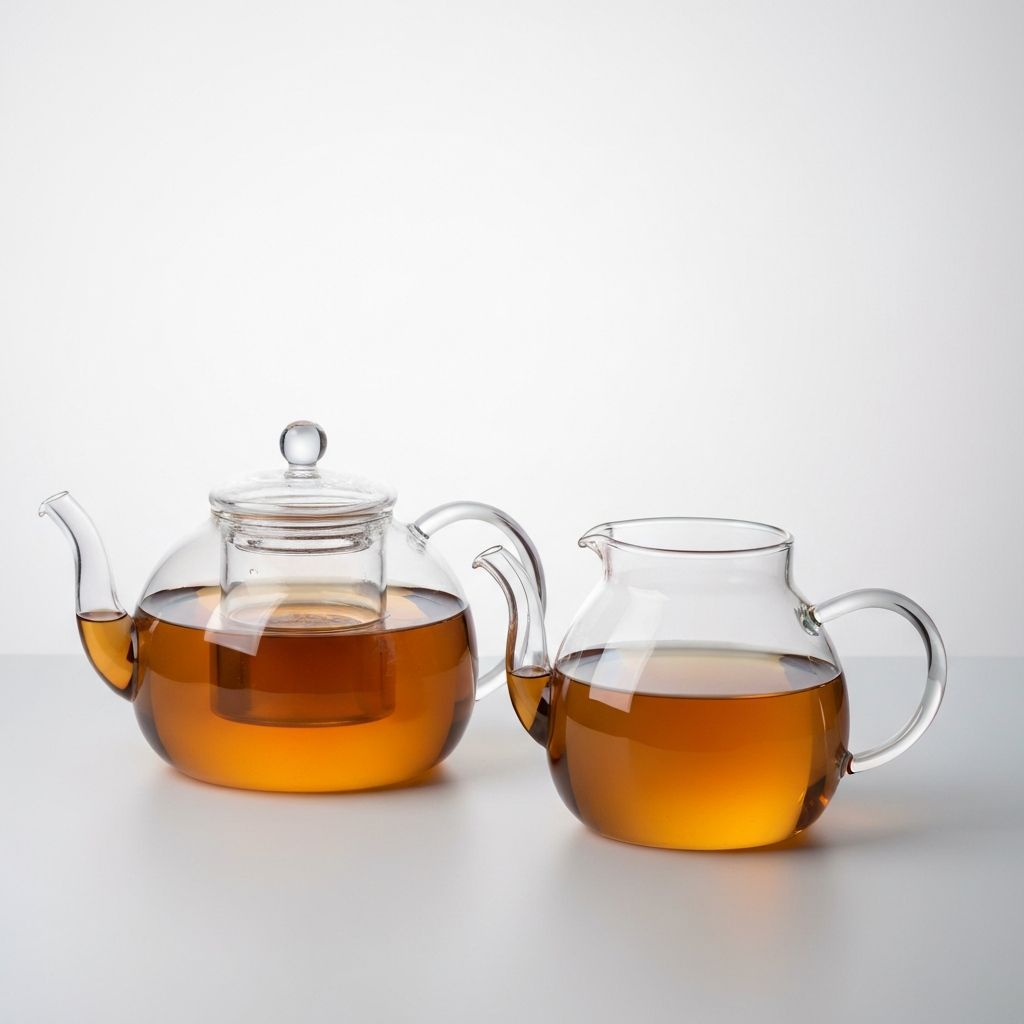
For glassware lines, the supplied product evidence illustrates how these criteria map to real items. Borosilicate teapots and pitchers in the 350–1500 ml range are offered with or without infusers and are described as thermal shock resistant; measuring cups from 250–1000 ml carry calibrated markings and are described as safe for direct heating; single-wall cups from 100–600 ml are specified as borosilicate 3.3 with heat resistance to 500°C. Each of these claims should be backed by the corresponding test data before a buyer treats it as a purchase specification.
Decision Rules for Choosing a Grade
Use these rules as a starting filter, then confirm with test data:
- Rapid temperature change in thin-walled ware: specify borosilicate 3.3 and require a thermal shock test at the expected differential plus a safety margin.
- High steady temperature with slow cycling: consider aluminosilicate or fused silica, and specify the maximum service temperature and load.
- Dishwasher or alkaline cleaning exposure: require chemical durability data and avoid grades with high alkali content unless tested.
- Cost-sensitive decorative or non-thermal use: soda-lime may be adequate, but do not label it heat resistant without test evidence.
The most common procurement error is accepting a generic “heat resistant” label without a differential, a cycle count, or a test method. The second most common is specifying a premium grade but ignoring edge quality and annealing, which determine whether that grade's margin survives real handling.