September 28, 2026
Double Wall Glass Mugs for Tea Enthusiasts – Perfect Temperature for Every Sip
1. Introduction
Tea enthusiasts know that temperature is everything. The perfect cup of green tea requires water around 80°C. Black tea needs water at 95°C or higher. Oolong falls somewhere in between. Once the tea is poured, the mug's ability to maintain that temperature determines whether you experience the full flavor profile or a disappointing lukewarm compromise.
The double wall glass mug has emerged as a preferred vessel for tea drinkers who value both function and aesthetics. Unlike single-wall glass that cools quickly and burns your hands, or ceramic that hides the tea's color and clarity, the double wall design offers a unique combination of insulation, safety, and visual appeal.
2. The Science of Double Wall Insulation
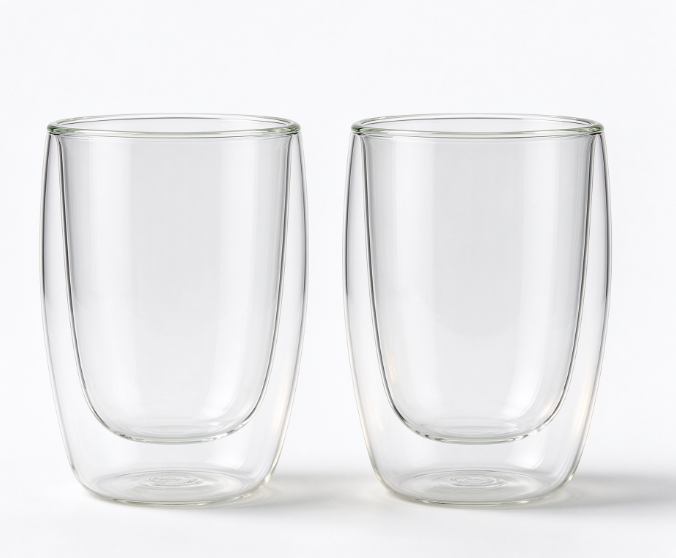
The principle behind double wall glass mugs is straightforward: two layers of glass separated by a sealed air gap. This gap acts as a thermal barrier, slowing heat transfer from the liquid inside to the outer wall.
How the insulation works. Air is a poor conductor of heat, with a thermal conductivity of approximately 0.024 W/m/°C, while glass itself conducts heat at 0.96 to 1.3 W/m/°C. The trapped air between the two layers significantly slows down heat transfer via conduction and convection. This means hot drinks stay hot longer, and cold beverages remain chilled longer.
Some premium double wall mugs use a vacuum layer rather than just air. By removing the air between the two layers, the vacuum eliminates both conduction and convection heat transfer, leaving only minimal radiation. This is the same principle used in high-end thermos flasks.
The temperature difference resistance. Quality double wall glass mugs are designed to withstand rapid temperature changes. The sealed air gap and high-quality glass construction allow these mugs to handle temperature differences of 120°C or more.
3. Material Matters – Why Borosilicate Glass Is the Standard
The material choice is just as important as the design. The vast majority of double wall glass mugs are made from borosilicate glass, specifically 3.3 borosilicate glass.
What makes borosilicate different. Borosilicate glass contains boron trioxide and has a low coefficient of thermal expansion. This means it does not crack under extreme heat and can cope with temperatures up to 100°C or higher. The linear coefficient of thermal expansion for 3.3 borosilicate glass is roughly one-third that of soda-lime glass.
Thermal shock resistance. This lower expansion rate allows the mug to move from refrigerator to microwave without cracking. Borosilicate glass can withstand temperature differences of up to 180K or more. Soda-lime glass, while cheaper, cannot reliably survive the same thermal cycling and fails frequently when boiling water is poured in straight from the kettle.
Thermal conductivity. At 90°C, the thermal conductivity of borosilicate glass is approximately 1.2 W/(m·K). This relatively low thermal conductivity contributes to the mug's insulating properties, though the air gap between the walls does most of the work.
4. Performance That Matters – Heat Retention and Cooling Curves
The real test of any tea mug is how well it keeps your drink at the right temperature. Data from controlled testing confirms that double wall glass mugs significantly outperform single-wall alternatives.
Direct comparison data. A test conducted with boiling water at 25°C room temperature showed the following cooling curves:
Time After Pouring | Single Wall Temperature | Double Wall Temperature |
0 minutes | 95°C | 95°C |
30 minutes | 55°C | 72°C |
60 minutes | 38°C (lukewarm) | 58°C |
90 minutes | 30°C (room temp) | 48°C (warm) |
120 minutes | 27°C | 40°C (still drinkable) |
The difference is clear. After one hour, a single-wall mug is already lukewarm at 38°C. The double-wall mug remains hot at 58°C. After two hours, the double-wall mug is still warm at 40°C, while the single-wall mug has gone cold.
Additional testing confirms the pattern. In another facility test, identical 300ml pours of boiling water lost roughly 12°C over 15 minutes in a single-wall cup versus only 6°C in a properly annealed double wall cup.
Hot drinks stay hot for up to 30 minutes in a double wall mug, while cold beverages remain chilled twice as long as those in single-walled glassware. For tea enthusiasts who enjoy a slow, contemplative drinking experience, this performance difference is the difference between a satisfying session and a rushed finish.
5. Comfort and Safety – No More Burnt Hands
One of the most immediate benefits of a double wall glass mug is safety. The outer wall remains cool to the touch even when the inner wall holds boiling water.
Temperature data. A double-wall glass mug keeps the outer surface at approximately 35 to 40°C, which is warm but comfortable to hold. By contrast, pouring boiling water into a single-wall glass container causes the outside to reach 70 to 80°C within seconds. Skin contact with temperatures above 60°C can cause burns in seconds.
The safety difference matters. At the office, you pick up your mug dozens of times a day. In a café setting, customers should not need a sleeve or towel to hold their cup. The double wall design eliminates the need for any protective covering, allowing the drinker to appreciate the mug's design and the tea's color without distraction.
Mug warmers and double-wall mugs. It is worth noting that double-wall insulated mugs are the worst choice for use on mug warmers—they block heat by design. If you use a mug warmer, stick with ceramic or single-wall glass.
6. Condensation Elimination – Protecting Surfaces
Condensation is a nuisance that double wall glass mugs eliminate entirely.
Cold drinks and sweating. When you place a cold drink in a single-wall glass, the outer surface gets cold and attracts moisture from the air. Water droplets form and drip onto your desk, leaving water rings on wood and paper. This damages surfaces and creates an untidy workspace.
The double-wall advantage. With a double-wall mug, the outer wall stays close to room temperature regardless of what is inside. No condensation means no water rings, no drips, no damage to wooden surfaces or important documents.
Practical impact. In a tea shop or café, eliminating condensation means coasters are optional rather than required. For office workers, it means important papers stay dry and desk surfaces remain clean.
7. Aesthetic Appeal – The Visual Experience
The double wall glass mug offers something no ceramic or metal mug can match: visual transparency.
The "floating" effect. The transparent, layered design creates a visually striking effect, allowing the rich hue of tea to take center stage. The liquid appears to float in mid-air, suspended between two layers of glass.
Taste neutrality. Unlike plastic or metal drinkware, glass is non-porous, meaning it will not absorb flavors or odors. Every sip tastes exactly as intended, free from unwanted aftertastes. This is particularly important for delicate teas where subtle flavor notes can be easily masked.
Sustainability. Glass is 100% recyclable and can be reused indefinitely without losing quality. A well-made double-wall glass mug is a long-term investment that reduces environmental impact.
8. Quality Indicators and Manufacturing Specifications
Not all double wall glass mugs are created equal. The quality of the mug depends on the manufacturing process.
Key specifications to verify:
Specification | Quality Indicator | Why It Matters |
Glass Type | 3.3 Borosilicate glass | Thermal shock resistance, durability |
Temperature Range | -20°C to 150°C or wider | Safe for boiling water and freezer use |
Thermal Shock Resistance | ≥ 180K | Withstands rapid temperature changes |
Gap Uniformity | Within 0.1mm | Consistent insulation, prevents stress fractures |
Annealing | Multi-zone controlled cooling | Prevents residual stress and failure |
Seal Integrity | Evacuation hole properly sealed | Prevents fogging between walls |
Industry standards. In China, QB/T 5035-2017 is the standard for double wall glass mugs, covering sensory quality, thermal shock resistance (700°C test), hydrolytic resistance, and capacity. GB/T 3532-2021 is another applicable standard. These standards ensure products meet minimum safety and quality requirements.
What to look for in a quality mug. A well-made double wall glass mug should have a uniform air gap with no visible bubbles or unevenness. The rim should be smooth and polished. The evacuation hole at the bottom—used to extract air from the gap during manufacturing—should be properly sealed. If moisture ever enters that cavity, condensation forms between the walls and the mug looks permanently fogged.
9. Conclusion
Double wall glass mugs are a practical choice for tea enthusiasts who value temperature control, safety, and visual clarity. The sealed air gap between the two glass layers provides effective insulation—single-wall mugs cool twice as fast, losing 12°C in 15 minutes compared to just 6°C for double-wall. The outer wall stays at a comfortable 35–40°C, eliminating the burn risk of single-wall glass that can reach 70–80°C. Condensation disappears entirely, protecting surfaces and maintaining a clean workspace.
Borosilicate glass provides the thermal shock resistance needed for everyday use—withstanding rapid temperature changes without cracking—and its non-porous surface ensures no flavor transfer from one cup to the next. For the tea enthusiast who takes their brewing seriously, the double wall glass mug is not just a vessel—it is an essential tool for experiencing tea at its best, from the first sip to the last.
10. Frequently Asked Questions (FAQ)
Q: Do double wall glass mugs really keep tea warmer longer?
A: Yes. A double-wall mug keeps tea at 58°C after one hour, compared to 38°C in a single-wall mug. After two hours, the double-wall mug is still drinkable at 40°C, while the single-wall has gone cold.
Q: Does the outer wall stay cool with boiling water inside?
A: Yes. The outer surface stays at approximately 35 to 40°C, which is warm but comfortable to hold. Single-wall glass reaches 70 to 80°C within seconds.
Q: Can I use a double wall glass mug on a mug warmer?
A: No. Double-wall insulated mugs are the worst choice for mug warmers—they block heat by design. Use ceramic or single-wall glass if you rely on a mug warmer.
Q: What glass material is best for double wall mugs?
A: 3.3 borosilicate glass is the standard. It has a coefficient of thermal expansion roughly one-third that of soda-lime glass, allowing it to withstand rapid temperature changes without cracking.
Q: Do double wall mugs sweat with cold drinks?
A: No. The outer wall stays close to room temperature regardless of what is inside, so condensation does not form.
Q: Are double wall glass mugs dishwasher safe?
A: Most are, but check the manufacturer's specifications. Some handmade mugs with delicate seals may require hand washing.