September 28, 2026
Clear Visibility – Why Transparent Glass Measuring Cups Beat Opaque Alternatives
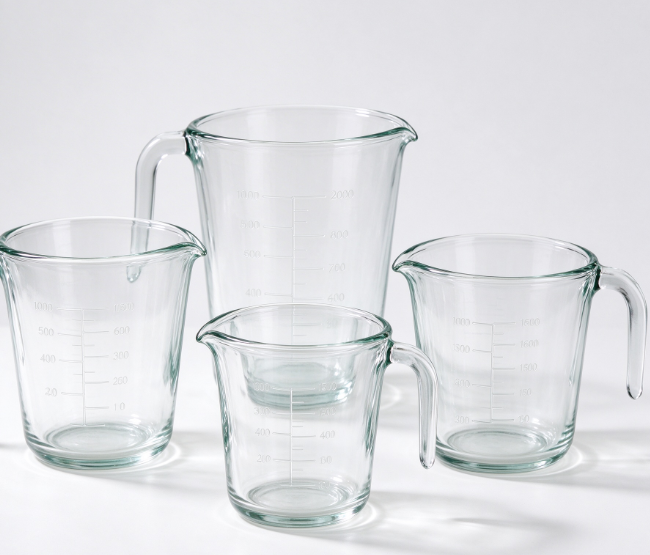
Table of Contents
Introduction
The Transparency Advantage – Seeing Is Measuring
Material Integrity – Borosilicate Glass and Thermal Performance
Hygiene and Maintenance – Non-Porous, Odor-Free, and Easy to Clean
Accuracy That Lasts – Permanent Markings and Dimensional Stability
The Opaque Alternative – Why It Falls Short
Conclusion
Frequently Asked Questions (FAQ)
1. Introduction
Measuring liquids is one of the most fundamental tasks in any kitchen, laboratory, or production environment. The tool you choose determines not only the accuracy of your measurements but also the consistency of your results.
Transparent glass measuring cups offer a critical advantage that opaque alternatives cannot match: the ability to see exactly what you are measuring at eye level. This visibility, combined with the material's heat resistance, durability, and non-porous surface, makes glass the superior choice for anyone who demands precision. This review explores why transparent glass measuring cups consistently outperform their opaque counterparts.
2. The Transparency Advantage – Seeing Is Measuring
The core advantage of a transparent glass measuring cup is simple: you can see the liquid level clearly against the measurement markings. This is not a minor convenience—it is a fundamental requirement for accuracy.
Reading at eye level. For a truly accurate measurement, the cup should be placed on a flat surface and the liquid level read at eye level. Transparent glass allows you to do this easily. Opaque cups require you to look down into the cup or rely on markings on the inside, both of which introduce parallax error.
The "meniscus" problem. Liquids form a curved surface—a meniscus—at the top of the column. The correct measurement is read at the bottom of this curve. Transparent glass allows you to see the meniscus clearly against the markings. Opaque cups force you to guess or estimate the position of the meniscus, leading to inconsistent results.
Multiple measurement systems. Many high-quality glass measuring cups feature laser-etched markings in both metric and imperial units. The transparent body ensures that both sets of markings are clearly visible regardless of the angle from which you are viewing.
3. Material Integrity – Borosilicate Glass and Thermal Performance
Not all glass is the same. The best transparent measuring cups are made from borosilicate glass, a material specifically engineered for thermal shock resistance.
What is borosilicate glass? Borosilicate glass contains boron trioxide, which gives it a low coefficient of thermal expansion. This means it expands and contracts much less than ordinary glass when exposed to temperature changes. The result is exceptional resistance to thermal shock—the ability to withstand rapid temperature changes without cracking or shattering.
Temperature range. High-quality borosilicate glass measuring cups can handle temperatures from -40°F to 572°F (-40°C to 300°C). This makes them suitable for measuring hot liquids like boiling water, melted butter, or hot syrups directly from the stove.
The plastic alternative. Plastic measuring cups, by contrast, can warp or deform when exposed to hot liquids. A warped cup no longer provides accurate measurements. Plastic can also stain, retain odors, and become cloudy over time. Glass remains clear and dimensionally stable for the life of the product.
Thermal shock resistance data. Borosilicate glass is rated for thermal shock resistance up to 220°C. This means you can take a borosilicate measuring cup from the freezer and pour boiling water into it without fear of breakage. Soda-lime glass (the cheaper alternative) does not offer this protection.
4. Hygiene and Maintenance – Non-Porous, Odor-Free, and Easy to Clean
Glass is non-porous. This seemingly simple property has profound implications for hygiene and maintenance.
No absorption, no contamination. Non-porous glass does not absorb liquids, odors, or colors. You can measure tomato sauce, then rinse and measure milk—the milk will taste like milk, not tomato. Plastic, by contrast, can absorb odors and stains over time.
Easy cleaning. The smooth, non-porous surface of glass resists sticking and is easy to clean. Most glass measuring cups are dishwasher safe, and even hand washing is quick and effective. There are no crevices for bacteria or residue to hide.
Long-term appearance. Glass does not scratch, cloud, or stain with normal use. A glass measuring cup will still look like new after years of service. Plastic cups often become scratched and cloudy, making markings difficult to read and creating hiding places for bacteria.
Microwave and oven safety. Many glass measuring cups are safe for microwave, oven, freezer, and refrigerator use. This versatility is not available with most plastic alternatives.
5. Accuracy That Lasts – Permanent Markings and Dimensional Stability
The markings on a measuring cup are only useful if they remain accurate and readable.
Permanent markings. High-quality glass measuring cups use laser-etched or baked-on markings that do not fade, wash off, or wear away. Plastic markings can fade or scratch off over time, rendering the cup useless for precise measurement.
Dimensional stability. Glass does not warp, deform, or change shape over time. A glass measuring cup purchased today will have the same internal volume ten years from now. Plastic can warp from heat, age, or mechanical stress, altering the cup's capacity and compromising accuracy.
America's Test Kitchen verification. In testing, glass measuring cups were found to be accurate and durable, with bold, easy-to-read measurement lines. The glass did not stain and emerged from tests looking like new.
6. The Opaque Alternative – Why It Falls Short
Opaque measuring cups—whether metal, ceramic, or colored plastic—are fundamentally flawed for liquid measurement.
No visual confirmation. With an opaque cup, you cannot see the liquid level against the markings. You must guess or rely on a dipstick, both of which introduce significant error.
Parallax error. When you look down into an opaque cup, the angle of your view distorts the perceived liquid level. This parallax error can change a measurement by several percent—enough to ruin a delicate recipe.
Design as impairment. One design project explicitly set out to create a measuring cup that is "worse" by making it opaque. The result was a product that is "special and challenging to measure liquid accurately". This illustrates the fundamental principle: opaque measuring cups are intentionally or unintentionally worse than transparent ones for their primary purpose.
The metal exception. Metal measuring cups have markings on the inside, which requires you to look down into the cup. This introduces the same parallax error as other opaque designs. Metal also cannot be used in microwave ovens and does not allow visual monitoring of the liquid.
7. Conclusion
Transparent glass measuring cups are fundamentally superior to opaque alternatives for liquid measurement. The transparency allows for precise, parallax-free reading of liquid levels against permanent markings. The material—particularly borosilicate glass—provides thermal shock resistance, dimensional stability, and resistance to staining and odors.
Plastic cups warp, stain, and absorb odors. Opaque cups hide the liquid level and introduce measurement error. Metal cups cannot be used in microwaves and rely on internal markings that are difficult to read.
For anyone who values accuracy, durability, and hygiene in their measurements, transparent glass measuring cups are the clear winner. The ability to see what you are measuring is not just a convenience—it is the foundation of accurate, repeatable results.
8. Frequently Asked Questions (FAQ)
Q: Why is transparency important in a measuring cup?
A: Transparency allows you to see the liquid level clearly against the measurement markings. This enables accurate, parallax-free reading of the meniscus and prevents overfilling or underfilling. Opaque cups hide the liquid level and introduce measurement error.
Q: What is borosilicate glass and why does it matter?
A: Borosilicate glass contains boron trioxide, which gives it a low coefficient of thermal expansion. This makes it highly resistant to thermal shock—it can withstand rapid temperature changes without cracking. Borosilicate glass measuring cups can handle temperatures from -40°F to 572°F (-40°C to 300°C).
Q: Can plastic measuring cups be as accurate as glass?
A: Not over time. While a new plastic cup may be accurate initially, plastic can warp from heat, stain, become cloudy, and absorb odors. Plastic markings can fade or scratch off. Glass remains dimensionally stable and its markings are permanent.
Q: Are glass measuring cups dishwasher safe?
A: Most glass measuring cups are dishwasher safe. Their smooth, non-porous surface is easy to clean and does not absorb residues. Always check the manufacturer's instructions for specific care recommendations.
Q: Why should I read a liquid measurement at eye level?
A: Reading at eye level eliminates parallax error—the distortion that occurs when you view a measurement from an angle. Transparent glass allows you to place the cup on a flat surface and read the measurement at eye level easily. Opaque cups force you to look down into the cup, introducing error.
Q: Can glass measuring cups go from freezer to oven?
A: Borosilicate glass measuring cups can withstand thermal shock up to 220°C and are safe for freezer, microwave, and oven use. However, always check the manufacturer's specifications, as not all glass is created equal. Soda-lime glass does not offer the same thermal shock resistance.